

A coupling agent that survives 380 °C
IC® — Interface Connect — is a VOC-free coupling platform serving the filler and polymer industries: it treats filler surfaces so they bond into polymer matrices. PTFE is our proving ground, not our boundary — IC® has already been line-trialled in FKM and has bonded IC®-Mica into PA. In PTFE, IC® clears the loading barrier, so materials carry 30–40% mica loading, where conventional filled PTFE plateaus at 20–25%, at equivalent or better performance — at production scale.
Why filled PTFE stopped improving
PTFE is chemically inert — that’s why it’s valuable, and why so little bonds to it. Conventional filled PTFE is a blend, not a composite: the filler sits in the matrix without attaching to it.
Above roughly 20–25% loading, unbonded filler stops reinforcing and starts creating defects. Creep, wear and dimensional drift follow.
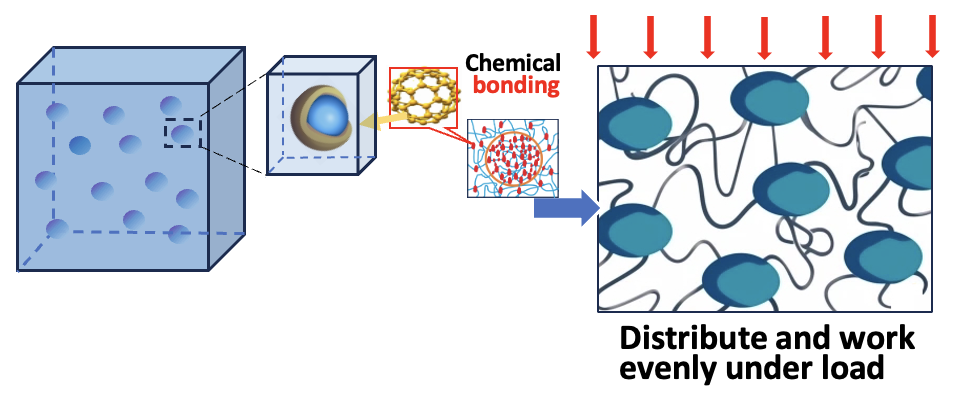
IC® treats the filler surface so it bonds into PTFE. Load transfers cleanly across the interphase — and loadings the industry considered impossible become routine.
Filler loading, reinforced
Loading depends on mica type — the comparison holds the mica constant. Filler that bonds, reinforces. Filler that doesn’t, weakens.The interface has to survive the oven.
PTFE is sintered at around 380 °C. That single number decides which surface chemistries are available to it.
Silane coupling agents are the standard answer everywhere else in filled polymers — glass into epoxy, mineral into polypropylene. We tried the standard aminosilane, KH550, on mica destined for PTFE. It did not survive sintering. Whatever bond it forms at the filler surface is gone before the part exists.
Fluorosilanes are the closer relative — chemistry designed for fluorinated surfaces, and a genuine coupling agent for PTFE systems. How much of that coupling survives a full sinter cycle, and how efficiently it transfers load once there, is the open question.
IC® goes through PTFE sintering at 380 °C and comes out still doing its job. That is the claim: not that nothing else couples to PTFE, but that the interface has to survive the oven — and then carry load.
Surface treatments for filler in PTFE
| Surface treatment | Survives PTFE sintering (about 380 °C) | Couples filler into the PTFE matrix |
|---|---|---|
| None — untreated filler | Not applicable | No — the filler sits in the matrix, not bonded to it |
| Aminosilane (e.g. APTES / KH550) | No — did not survive sintering in our tests on mica | Not once the part is sintered |
| Fluorosilane | Not established at PTFE sinter conditions | Yes in principle — coupling efficiency in PTFE is the open question |
| IC® (Interface Connect) | Yes — processed through sintering at 380 °C | Yes — load transfers across a durable interphase |
Three steps from inert to engineered
Treat the filler
IC® surface chemistry makes fillers “speak PTFE” — dispersing evenly and coupling to the matrix instead of sitting in it.
Build the interphase
A durable interphase forms between polymer and filler, so mechanical load transfers cleanly under stress, heat and cycling.
Tune the system
Filler type and loading tuned to your PV, temperature, media and counterface — validated in focused ASTM/ISO test programs.
The weakest link becomes the strongest
- Higher stiffness, lower creep — the filler carries load instead of concentrating stress.
- Lower wear rates — bonded filler stays anchored under sliding contact.
- Tighter tolerances — reduced shrinkage and dimensional drift.
- Even dispersion — treated fillers distribute uniformly and work evenly under load.
- VOC-free — no solvents at any stage, at production scale.
Tell us what your part has to survive.
Send us your polymer, compound, PV, temperature and media — we’ll tell you honestly whether IC® can help.
Book a technical call